


Color Mixing Engine
Subtractive & Additive Real-time Blend
Mixing pink and green usually produces a muted neutral such as brown, gray, beige, taupe, or an earthy olive tone. The exact result depends on the shades, pigments, and amount of each color you mix.
For example, light pink mixed with mint green can create a pale, soft neutral, while hot pink mixed with a deep green can produce a darker brown or gray-brown. Different pigments can also push the result toward mauve, olive, or a muted green.
If you’re mixing paint, the easiest way to predict the result is to consider the undertones, lightness, saturation, and ratio of your pink and green.
Pink and Green: The Quick Answer
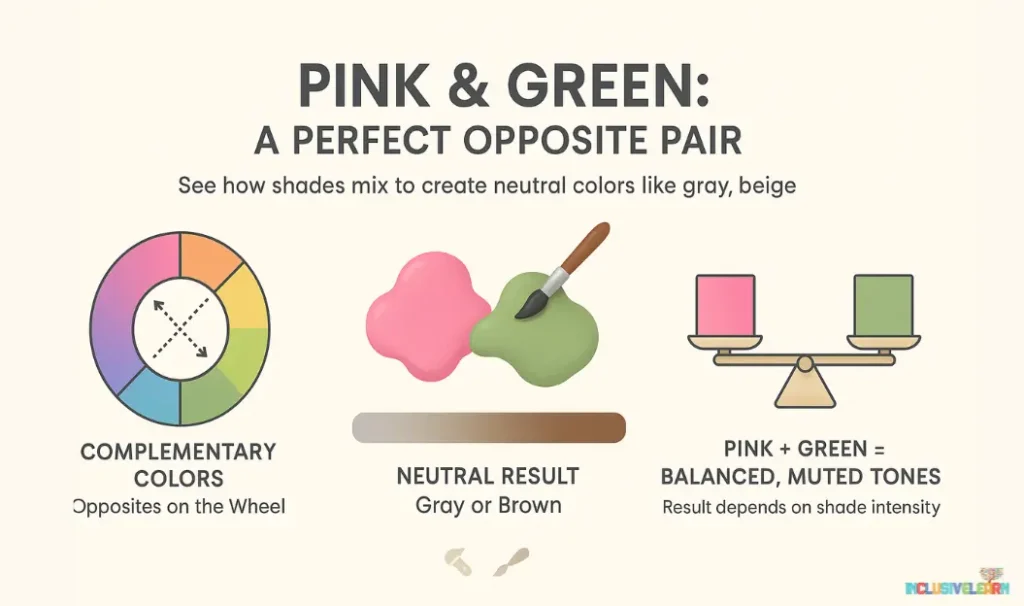
When you mix pink and green paint, expect a muted neutral color, most commonly a grayish brown, brown, beige, taupe, or olive-leaning shade.
The reason is that pink is generally treated as a lighter tint of red, while green is the complementary color of red in traditional pigment-based color theory. When these color families are mixed as pigments, their stronger hues become less saturated and the mixture moves toward a neutral or earthy color.
The result isn’t always exactly the same because there is no single “pink” or “green” pigment.
| Pink + Green Combination | Likely Result |
|---|---|
| Light pink + mint green | Pale gray, beige, or soft neutral |
| Soft pink + medium green | Gray-brown or muted green |
| Rose pink + green | Taupe, brown, or gray |
| Hot pink + bright green | Muddy brown or muted neutral |
| Magenta + forest green | Dark brown, gray, or olive-brown |
| Pink + blue-green | Cool gray, muted mauve, or blue-green neutral |
These are general results rather than guaranteed formulas. Actual paint mixtures can vary significantly by pigment and brand. Hands-on paint tests show a broad range of gray, brown, olive, and mauve-like results from different pink and green combinations.
Why Do Pink and Green Make a Neutral Color?
The key is understanding what pink represents in traditional pigment-based color mixing.
Pink is commonly created by adding white to red. Green is a secondary color made from blue and yellow. Because red and green sit opposite each other in the traditional color wheel, they have a strong neutralizing relationship.
When you combine a pink pigment with green:
- The red component of the pink works against the green.
- The white already present in a light pink makes the mixture lighter.
- The two strong hues become less saturated.
- The final mixture moves toward brown, gray, beige, taupe, or another muted tone.
So saying that “pink and green are complementary colors” is an oversimplification. Red and green are complementary; pink inherits some of that relationship because it is generally treated as a tint of red.
Pink Is Not a Primary Color
Pink isn’t normally listed as a primary color in traditional paint-based color theory.
A simple way to think about it is:
Red + White = Pink
That white component matters when you mix pink with another pigment. It can produce a lighter and less intense result than mixing a saturated red directly with green.
What Happens When You Mix Pink and Green Paint?
Paint mixing is subtractive because physical pigments absorb parts of the light that reaches them. As you combine more pigments, the mixture generally becomes darker and less saturated.
That’s why pink and green paint doesn’t produce a bright new color in the way colored light can.
Instead, the mixture usually becomes a muted brown, gray, beige, taupe, or earthy green.
The exact result depends on:
- The pink pigment
- The green pigment
- The amount of white already present
- The ratio of each color
- Pigment strength
- Paint brand and formulation
- Whether the colors are warm or cool
This is why two tubes both labeled “pink” can produce noticeably different results when mixed with the same green.
Does the Shade of Pink Change the Result?
Yes. This is one of the biggest reasons your result can vary.
A pale pastel pink contains more white and generally produces a lighter mixture. A saturated magenta contains much stronger color and can produce a darker or more intense neutral when mixed with green.
Light Pink + Green
Light pink contains a substantial amount of white, so it can produce lighter neutrals when mixed with green.
Depending on the green, you might get:
- Pale gray
- Soft beige
- Gray-green
- Light taupe
- Muted olive
A pastel pink with mint green is likely to look much softer than hot pink mixed with forest green.
Rose Pink + Green
Medium rose or dusty pink usually creates a middle-value neutral.
Depending on the green, the result can lean toward:
- Taupe
- Gray-brown
- Muted brown
- Olive-brown
Hot Pink + Green
Hot pink or strong magenta contains much more saturated pigment.
When mixed with a deep or strong green, the result can become:
- Dark brown
- Gray-brown
- Olive-brown
- Deep muted neutral
Painting experiments using different pink and green pigments show that changing the starting colors can produce substantially different results.
What Happens When You Change the Amount of Each Color?
The ratio matters almost as much as the colors themselves.
More Pink Than Green
Adding more pink generally makes the mixture warmer and can leave a pink, rosy, or reddish undertone.
For example:
3 parts pink + 1 part green
may create a warm taupe, dusty rose-brown, or light brown depending on the pigments.
Equal Pink and Green
A roughly 1:1 mixture is a useful starting point when you’re trying to neutralize the two colors.
It may produce:
- Gray
- Gray-brown
- Brown
- Beige
- Muted olive
The exact result depends on pigment strength, so equal amounts don’t guarantee a specific color.
More Green Than Pink
Increasing the green can leave the mixture cooler and more earthy.
For example:
1 part pink + 3 parts green
may create:
- Muted olive
- Mossy green
- Green-gray
- Khaki-like neutral
- Dark earthy brown
Current color-mixing examples similarly show that changing the pink-to-green ratio can move the mixture between warmer brown/taupe shades and cooler, greener neutrals.
What Color Does Light Pink and Green Make?
Light pink and green generally produce a lighter, muted neutral rather than a strong dark brown.
Depending on the green, possible results include:
- Pale gray
- Soft beige
- Light taupe
- Gray-green
- Muted olive
For a very soft result, try a pastel pink with mint or another pale green.
Because the pink already contains white, it can lift the value of the final mixture.
What Color Does Hot Pink and Green Make?
Hot pink mixed with green usually creates a darker, more saturated neutral.
Depending on the shades, you may get:
- Muddy brown
- Dark gray-brown
- Olive-brown
- Deep muted neutral
A strong green can overpower a lighter pink, while a highly saturated magenta can pull the mixture toward a warmer or purplish neutral.
What Color Does Mint Green and Pink Make?
Mint green and pink usually create a soft, muted color.
The result can range from:
- Pale gray
- Beige
- Soft taupe
- Dusty mauve
- Muted green
The exact outcome depends on whether the pink is warm, cool, pale, or highly saturated.
If both colors contain a lot of white, the mixture will generally appear much lighter than a combination of dark green and hot pink.
Can Pink and Green Make Purple?
Usually, pink and green do not produce a clear, bright purple.
However, certain pigment combinations can create muted mauve or purple-leaning colors.
This is especially possible when the pink is closer to magenta and the green contains strong blue undertones. Real paint tests show that some combinations can move toward dusty mauve or purple rather than staying strictly brown or gray.
If your goal is a clean purple, mixing red and blue is a more direct approach in traditional paint mixing.
Can Pink and Green Make Beige?
Yes.
A light pink mixed with a pale or muted green can produce a soft beige or taupe-like neutral, especially when the mixture contains enough white.
If your mixture looks too green, add a little more pink. If it looks too pink, add a small amount of green.
Add the second color gradually rather than adding a large amount at once.
Can Pink and Green Make Brown?
Yes. Brown is one of the most common results when mixing pink and green pigments.
The exact brown can range from:
- Light tan
- Warm beige
- Taupe
- Gray-brown
- Earthy brown
- Dark muddy brown
A darker green combined with saturated pink is more likely to produce a darker, muddier result than pastel colors.
Paint vs. Digital Color: Why the Results Differ
It’s important not to treat paint and screen colors as if they use exactly the same mixing system.
Paint and Pigments
Paint uses physical pigments that absorb and reflect light. Combining pigments generally reduces the amount of light reflected from the mixture.
This is why mixing pink and green paint tends to produce a muted neutral rather than a bright new color.
RGB Screens
Screens use RGB light: red, green, and blue.
This is additive color mixing. Adding colored light increases the amount of light reaching your eyes.
You should therefore not assume that mixing RGB values will reproduce the same result as physically mixing pink and green paint.
CMYK Printing
CMYK is a subtractive printing model based on cyan, magenta, yellow, and black inks. A digital color value can also look different when converted from a screen to printed ink because the materials and color spaces are different.
For a painting project, use actual paint samples. For a digital project, use the color values and blending tools in your design software.
How to Mix Pink and Green Paint
If you want to test the combination yourself, start with small amounts.
What You Need
- Pink paint
- Green paint
- Mixing palette
- Palette knife or clean brush
- Scrap paper or canvas
- White paint for lightening
- Optional black or darker pigment for deepening
Step-by-Step
- Place a small amount of pink and green on your palette.
- Start with approximately equal amounts.
- Mix them thoroughly with a palette knife or clean brush.
- Observe the resulting neutral color.
- Add more pink if you want a warmer result.
- Add more green if you want a cooler or earthier result.
- Add white if the mixture is too dark.
- Test the color on scrap paper or your intended surface.
- Allow the paint to dry if you’re using a medium that changes appearance while drying.
- Adjust the mixture gradually until you reach the shade you want.
Don’t mix a large quantity immediately. A small test lets you correct the ratio without wasting paint.
Simple Pink and Green Mixing Recipes
These are starting points rather than guaranteed formulas because paint pigments vary.
| Starting Mix | Approximate Direction |
|---|---|
| 1 pink + 1 mint green | Pale gray, beige, or soft neutral |
| 2 pink + 1 green | Warmer taupe or rosy beige |
| 1 pink + 2 green | Cooler muted green or olive |
| 1 hot pink + 1 dark green | Dark brown or gray-brown |
| 2 light pink + 1 green | Pale warm neutral |
| 1 magenta + 1 blue-green | Cool gray, mauve, or muted blue-green |
The best way to hit a particular shade is to mix a small test batch first and adjust one color at a time.
Common Mistakes When Mixing Pink and Green
You don’t need a long list of complicated rules. A few simple mistakes account for most disappointing results.
Using Too Much of One Color
Adding a large amount of green to a small amount of pink can make the result strongly green or olive. The same happens when saturated pink overwhelms a weak green.
Start small and adjust gradually.
Assuming Every Pink Behaves the Same
Baby pink, rose, coral pink, magenta, and hot pink have different undertones and pigment strengths.
The label “pink” doesn’t tell you exactly how it will behave in a mixture.
Assuming Every Green Behaves the Same
Mint, lime, emerald, forest, olive, and blue-green pigments can produce very different results.
Mixing Too Many Colors
If you keep adding extra colors to correct a mixture, it can quickly become muddy.
Start with pink and green, evaluate the result, and make one adjustment at a time.
Judging Wet Paint Too Quickly
Some paints change slightly as they dry. If the final color matters, let a small test sample dry before making a large batch.
Pink and Green Together Without Mixing
Pink and green can also work well as a color combination without physically mixing them.
This is different from asking what color they make when combined as paint.
Some combinations include:
- Pink + mint green
- Blush pink + sage green
- Hot pink + emerald green
- Rose pink + olive green
- Pastel pink + pale green
Pink and Mint Green
Pink and mint green create a soft, fresh combination that works well for children’s spaces, spring themes, stationery, illustrations, and light decorative palettes.
Pink and Dark Green
Dark green creates stronger contrast with pink.
Hot pink and emerald or forest green can produce a bold, high-contrast look in artwork, fashion, graphics, and decorative projects.
Pink and Sage Green
Sage green is softer than emerald or forest green, so it creates a calmer combination with blush or dusty pink.
Why Does the Exact Result Change?
There isn’t one universal “pink” and one universal “green.”
The final mixture depends on several factors:
Hue
The underlying color family matters. A magenta pink behaves differently from a peach pink.
Value
Light colors contain more white or have a higher value. Dark colors produce deeper mixtures.
Saturation
Highly saturated colors can produce stronger neutralization when combined with an opposing pigment.
Temperature
Warm pinks and cool greens can create different undertones from cool pinks and warm greens.
Ratio
Changing the amount of either color can shift the result considerably.
Pigment
Two paints with the same basic color name can contain different pigments and behave differently when mixed.
This is why color-mixing charts are useful for planning, but a small physical test remains the most reliable way to check the final paint color.
Frequently Asked Questions
Pink and green paint usually create a muted neutral such as brown, gray, beige, taupe, or olive. The exact result depends on the shades, pigments, and ratio.
No. Brown is common, but the mixture can also produce gray, beige, taupe, muted olive, or other earthy tones. Different shades and ratios can change the result.
Light pink and green generally produce a lighter neutral such as pale gray, beige, soft taupe, or muted green. The amount of white already present in the pink affects the result.
They usually don’t produce a clean purple, but certain magenta and blue-green combinations can create muted mauve or purple-leaning shades.
Final Answer: What Color Does Pink and Green Make?
So, what color does pink and green make?
The short answer is usually a muted brown, gray, beige, taupe, or earthy neutral.
The exact result depends on the pink and green you start with, their undertones, the amount of each color, and the type of paint or medium you’re using.
For the most predictable result, start with a small 1:1 test, then adjust the mixture gradually. More pink can make the result warmer, while more green can push it toward a cooler, earthier shade.
If you’re working with paint, test the actual pigments you plan to use rather than relying on a generic color chart. That’s the easiest way to see exactly what your particular pink and green will create.