


Ask ten parents how much screen time is healthy and you will likely get ten different answers. Some households have strict one-hour limits. Others allow screens freely on weekends. Some parents feel guilty about every extra minute; others have stopped counting entirely.
The science behind screen time has also shifted significantly. In 2026, the American Academy of Pediatrics (AAP) moved away from the simple “two-hour rule” that guided parents for years and introduced a more nuanced framework that considers not just how much time children spend on screens, but what they are doing, why they are doing it, and what it is replacing.
This guide explains the current guidelines, breaks them down by age, and gives parents practical tools for making decisions that work for their family and their child.

Screen Time Guidelines by Age (AAP 2026)
The following guidelines come from the American Academy of Pediatrics and align with World Health Organization recommendations on sedentary behavior in early childhood.
Under 18 months: Avoid screen use entirely, with one exception: video calls with family members. A grandparent on FaceTime is not the same as a child passively watching YouTube videos. Video calls involve two-way interaction, turn-taking, and real human connection, which is why the AAP treats this differently.
The reason for avoiding screens at this age is straightforward. Infants and very young toddlers learn language, social responses, and emotional regulation through direct back-and-forth interaction with caregivers. A screen cannot provide the responsive interaction a developing brain needs most.
18 to 24 months: Limited, high-quality educational content with a parent present. At this age, children begin developing the cognitive ability to transfer learning from screens to real life, but only when a caregiver helps them make that connection. Watching together and talking about what is on screen turns passive viewing into an active learning experience.
2 to 5 years: Up to 1 hour per day of high-quality programming, with a parent co-viewing when possible. At this age, choose programs designed specifically for early childhood learning, those with slower pacing, simple narratives, and characters who model conversation and problem-solving.
6 to 12 years: The AAP no longer specifies a fixed daily limit for children in this range. Instead, it recommends that parents set consistent, reasonable limits that ensure screen use does not crowd out sleep, physical activity, homework, and face-to-face relationships. For most children, this works out to two to three hours of recreational screen time on school days and more flexibility on weekends.
Teenagers: No fixed limit, but consistent expectations matter. Screen time for teens includes social media, gaming, entertainment, and school-required work. Parents should focus on whether recreational screen use is affecting sleep, academic performance, mood, or in-person relationships rather than watching a clock.
Children with learning differences, attention difficulties, or emotional regulation challenges may need additional support setting and respecting screen time boundaries.
The 5 Cs: The Framework That Replaced the 2-Hour Rule
The AAP’s 2026 shift away from a universal time limit reflects what research has consistently shown: the same amount of screen time can be beneficial for one child and harmful for another, depending on context.
The 5 Cs framework asks parents to consider:
1. Child What is your specific child like? How do they respond to transitions off screens? Do they become dysregulated or irritable? Are screens a tool for calming down, and if so, is that the only tool they have? A child who can stop playing a game after 45 minutes with minimal friction is in a different situation than one who melts down every time a device is taken away.
2. Content Is what they are watching or doing educational, creative, or socially connecting? A 20-minute video call with a cousin is not the same as 20 minutes of algorithmically-served videos. An interactive coding app is not the same as passive scrolling. Quality matters at least as much as quantity.
3. Calm Does your child use screens to regulate emotions or fall asleep? If screens have become the primary or only way a child calms themselves, that dependency is worth addressing regardless of how many total minutes are involved. Children need multiple strategies for managing emotions and winding down.
4. Crowding Out What is screen time replacing? A child who reads, plays outside, engages with peers, sleeps well, and eats with the family is in a different position than one whose screen time is consistently replacing all of those activities. The question is not just how much time is on screens but what is being displaced.
5. Communication How does your family talk about screens? Are conversations about media use open and collaborative, or are they primarily about enforcement and limits? Children who understand why guidelines exist and who are involved in creating them tend to develop more responsible digital habits than those who simply have screens taken away.
For children who are learning about boundaries and self-regulation in general, these same conversations connect directly to broader skills.
What Counts as Quality Screen Time
Not all screen time works the same way in a child’s development. Pediatricians and researchers consistently distinguish between active and passive screen use.
Higher-quality screen time includes: Video calls with family members (involves real two-way interaction), educational apps with deliberate learning design, age-appropriate programming with slower pacing and prosocial content (PBS Kids, Sesame Workshop), creative tools such as drawing apps or age-appropriate coding programs, and co-viewing with a caregiver who asks questions and makes connections to real life.
Lower-quality screen time includes: Fast-paced content with frequent scene changes (associated with attention difficulties in young children), autoplay algorithms that remove natural stopping points, content with violence or high-stimulation feedback loops, passive scrolling through social media feeds, and screens used primarily as a behavior management tool without any engagement.
Common Sense Media maintains a free, regularly updated database of age-appropriate media ratings that many pediatricians recommend as a starting resource for evaluating content quality.
Signs Your Child May Be Getting Too Much Screen Time
The effects of excessive screen use are not always obvious in the moment. They tend to show up in adjacent areas of a child’s functioning over time.
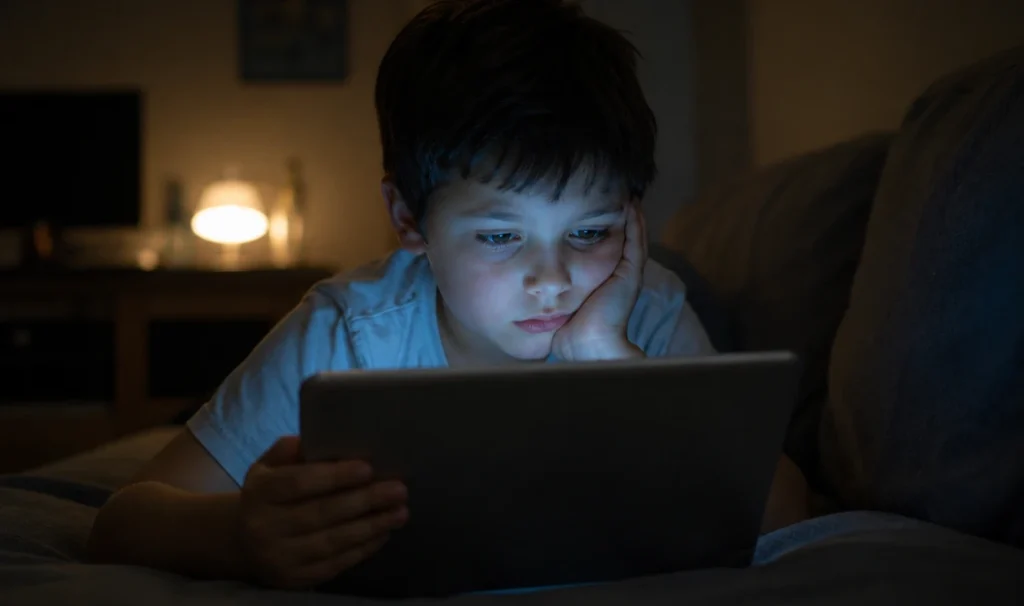
Sleep disruption. Blue light from screens suppresses melatonin production and signals the brain to stay alert. Children who use screens in the hour before bed consistently take longer to fall asleep and sleep less deeply. The sleep deprivation that results affects mood, attention, and learning the following day. For children who already have sleep challenges, screen use in the evening makes those challenges significantly harder to address.
Mood and emotional regulation changes. Children who spend extended time on screens, particularly on social media or highly stimulating games, often show increased irritability, frustration, and emotional reactivity. This is especially visible in the transition off screens, when children who are accustomed to constant stimulation struggle to tolerate the relative quiet of offline activities.
Attention and focus difficulties. Fast-paced screen content conditions the brain to expect constant stimulation and rapid scene changes. Extended exposure to this type of content can make it harder for children to sustain attention during slower-paced activities like reading, listening to instruction, or working through a problem independently.
Reduced interest in offline activities. A child who previously enjoyed drawing, playing outside, or building things but now wants only to use screens has likely had their offline interests crowded out. This is one of the clearest signs that screen time has reached a problematic level regardless of the total number of hours.
Eye strain and physical symptoms. Prolonged screen use causes digital eye strain: dry eyes, headaches, blurred vision, and difficulty focusing on distant objects. Regular breaks (the 20-20-20 rule: every 20 minutes, look at something 20 feet away for 20 seconds) reduce this meaningfully.
Children with conditions such as autism spectrum disorder, ADHD, or sensory processing differences may be particularly sensitive to some of these effects and may need more individualized approaches to screen time.
Practical Strategies for Setting and Keeping Limits
The most common frustration parents report about screen time is not setting limits but enforcing them consistently without ongoing conflict.
Start with a family media plan. The AAP offers a free interactive Family Media Plan tool at healthychildren.org that allows families to build a customized agreement covering which devices are used, when and where, what content is appropriate, and what offline activities take priority. Children who participate in creating the plan are significantly more likely to respect it.
Designate screen-free zones and times. Bedrooms, the dinner table, and the hour before sleep are the three locations and times where screens consistently cause the most harm and where removing them produces the clearest benefits. These boundaries apply to parents as well. Children observe and model adult behavior far more than they follow stated rules.
Use timers, not arguments. When screen time ends, a timer signals the transition rather than a parent’s judgment. Many children accept a timer going off much more readily than a parent saying “time to stop.” Give a five-minute warning before the timer ends.
Create a consistent bedtime routine that begins screens-off. All devices should leave the bedroom at a consistent time, ideally 60 minutes before the child’s target sleep time. Charging devices outside the bedroom overnight removes the temptation to check them after lights-out and is one of the most effective sleep hygiene practices for older children and teens.
Connect screen use to responsibility. For older children, earned screen time based on completed responsibilities (homework done, outdoor time had, reading completed) shifts the framing from restriction to autonomy. Children who see screen time as something they have control over through their choices tend to manage it better than those who experience it as something that happens to them or gets taken from them.

When Screen Time Is Genuinely Beneficial
Screens are not the enemy. In the right context, they are powerful tools for learning, connection, and creativity.
Educational content genuinely teaches. Research on programs like Sesame Street and equivalent quality children’s programming consistently shows vocabulary and concept learning that transfers to real life, particularly when caregivers watch alongside children and discuss what they are seeing.
Video calls maintain relationships. For children with family members in different cities or countries, regular video calls provide genuine connection and relationship maintenance that benefits their social and emotional development.
Creative tools support skill development. Age-appropriate animation tools, digital art apps, and introductory coding programs give children creative outlets and build problem-solving skills. The key is that the child is creating something, not only consuming.
Information access supports curious learners. Older children and teens who use screens to research topics they are genuinely interested in, who read, who watch documentaries, who follow tutorials to learn skills, are using screens in ways that support rather than crowd out development.
For children who learn differently, educational technology can also provide significant accommodations: text-to-speech, adjustable pacing, visual supports, and interactive formats that work better for some learners than traditional approaches.
Modeling: The Most Overlooked Factor
Children learn how to relate to screens by watching adults relate to screens. A parent who scrolls through their phone during dinner while asking a child to put their device away is communicating something that no stated rule can override.
Pediatricians from CHLA and other leading children’s hospitals consistently emphasize this point: healthy digital habits in children begin with adults modeling those habits. This includes putting your phone face-down during meals, not checking work emails in the first 30 minutes of the morning in view of your children, and showing your children what you do instead of reaching for a screen when you are bored, stressed, or waiting for something.
This does not require perfection. It requires consistency and honesty. Parents who acknowledge their own struggles with screen time and talk openly with their children about managing it are modeling exactly the self-awareness and regulation skills that make healthy screen habits possible.
Frequently Asked Questions
The AAP recommends up to 1 hour per day of high-quality educational programming for children aged 2 to 5, watched together with a parent when possible. For children under 18 months, the only recommended screen use is video calls with family.
Yes. High-quality educational content with parental co-viewing is treated more favorably in current guidelines than passive entertainment. However, the total amount still matters, especially for children under 5 whose brains need substantial offline learning time.
Involve your child in creating the rules, use timers to signal transitions rather than parent judgment, give five-minute warnings before screen time ends, and apply limits consistently. Children who know what to expect in advance resist transitions less than those who experience screen time ending as unpredictable.
This level of reaction often indicates that the child has limited strategies for managing boredom, disappointment, or transitions. This is worth addressing directly through consistent practice with transitions and emotion regulation, not by extending screen time to avoid the conflict. Speaking with a pediatrician or child psychologist can help if the reactions are severe or frequent.
Children with ADHD and autism often find screens highly regulating and rewarding, which can make limits harder to enforce. The same children may also be more sensitive to some of the negative effects of excessive screen use, particularly sleep disruption and difficulty transitioning. Individualized strategies and close observation of each child’s response are more useful than applying general guidelines rigidly.
No, but the conversation for teenagers shifts from parental control to collaborative expectation-setting. The focus should be on whether screen use is affecting sleep (most important), academic performance, mood, and in-person relationships. Teens who manage those areas well have demonstrated they can regulate their screen use; those who are struggling in those areas need support addressing screen use as a contributing factor.
Current guidance from pediatric sleep experts recommends stopping all screen use at least 60 minutes before target sleep time for children and adolescents. Devices should be charged outside the bedroom overnight. This applies to all screens, including phones, tablets, computers, and television.
Not inherently. The quality and content of the game, the social context (playing alone versus with friends), and whether it is crowding out sleep and offline activity matter more than the format. Highly violent games are a concern for younger children. Games that involve cooperative play, problem-solving, or creativity are more neutral or even positive depending on the child and the context.
What you’ve created here is more than just a series of words — it’s a journey. As I read through your work, I felt myself transported, not just through ideas, but through emotions and experiences I didn’t even realize I was missing. Your writing holds a mirror up to life in a way that encourages deep self-reflection, and that, in itself, is a rare and powerful gift.