
The letter E appears in many words children use every day, from egg and ear to elephant and excited. Practicing these words can help children build vocabulary, recognize letters, improve spelling, and develop early reading skills.
Some children are ready to read longer words, while others are still practicing simple three-letter words such as bed, pen, and red. That is why this list includes both everyday E words and words that help children practice the short E sound.
Whether you are a parent, teacher, or caregiver, you can use these word lists, sentences, and activities to make reading practice easier at home or in the classroom.
Easy E Words for Kids
Start with familiar words that children can connect to objects, animals, actions, and everyday experiences.
| Word | Simple Meaning |
|---|---|
| Ear | The body part used for hearing |
| Eat | To take food into your mouth |
| Egg | A food that comes from a bird |
| Eagle | A large bird with a hooked beak |
| Earth | The planet we live on |
| East | A direction |
| Easy | Not difficult |
| Echo | A sound that repeats |
| Edge | The outside line of something |
| Elf | A small imaginary character |
| Elk | A large animal related to deer |
| Elm | A type of tree |
| End | The last part of something |
| Engine | A machine that produces power |
| Enjoy | To have a good time |
| Enter | To go inside |
| Equal | The same in amount or value |
| Erase | To remove writing or marks |
| Error | A mistake |
| Even | A word that can mean level or equal |
| Ever | At any time |
| Every | Each one in a group |
| Example | Something that shows how a thing works |
| Exit | A way out |
| Eye | The body part used for seeing |
Try this: Choose five words from the table. Ask your child to say each word, explain what it means, and use it in a short sentence.
Three-Letter Words Starting With E
Three-letter words are useful for children who are beginning to recognize letters and spell simple words.
- Ear
- Eat
- Egg
- Eel
- Ebb
- End
- Eve
- Eye
Here are a few examples in sentences:
- My ear hurts.
- I eat an apple.
- The egg is in the bowl.
- The eel swims in the water.
- This is the end.
- My eye is blue.
Four-Letter Words Starting With E
These words give children more spelling practice while introducing familiar vocabulary.
- Each
- Earn
- Ease
- East
- Easy
- Echo
- Edge
- Edit
- Else
- Emit
- Epic
- Even
- Ever
- Evil
- Exam
- Exit
Some words, such as emit and epic, may need a quick explanation. Choose words based on your child’s reading level rather than asking them to memorize every word at once.
Five-Letter Words Starting With E
Once children feel comfortable with shorter words, introduce these five-letter examples.
- Eager
- Eagle
- Early
- Earth
- Eight
- Elbow
- Elder
- Empty
- Enjoy
- Enter
- Equal
- Error
- Event
- Every
- Exact
- Extra
- Eaten
- Edits
Ask children to choose a word and draw a picture that shows its meaning. For example, they might draw an elbow for elbow or a bird for eagle.
Longer E Words for Kids
Longer words help children build vocabulary and practice reading words with more than one syllable.
- Elephant
- Envelope
- Exercise
- Excellent
- Excited
- Education
- Energy
- Everyone
- Everything
- Evergreen
- Experiment
- Emergency
- Electricity
- Environment
- Entertainment
You can break longer words into smaller sound parts. For example, say el-e-phant slowly, then repeat the whole word at a natural speed.
E Words for Toddlers
Toddlers usually benefit from short, familiar words connected to things they see and do.
- Ear
- Eat
- Egg
- Eye
- End
- Easy
Point to an ear, an eye, or an egg in a picture book. Say the word clearly and give your child time to repeat it. There is no need to turn the activity into a test. A few minutes of playful practice is enough.
E Words for Preschoolers
Preschoolers can begin practicing words with different lengths and meanings.
- Eagle
- Earth
- Easy
- Echo
- Elbow
- Empty
- Enter
- Enjoy
- Every
- Exit
- Engine
- Erase
Use these words during everyday activities. For example, ask your child to erase a mark on paper or point to an empty cup.
E Words for Kindergarten Students
Kindergarten children can practice recognizing beginning letters, reading simple words, and writing short sentences.
- Egg
- Ear
- Eat
- End
- East
- Edge
- Even
- Ever
- Event
- Extra
- Enjoy
- Enter
- Eager
- Empty
- Every
For more alphabet practice, try the related lists of A words for kids, B words for kids, C words for kids, and D words for kids.
What Is the Short E Sound?
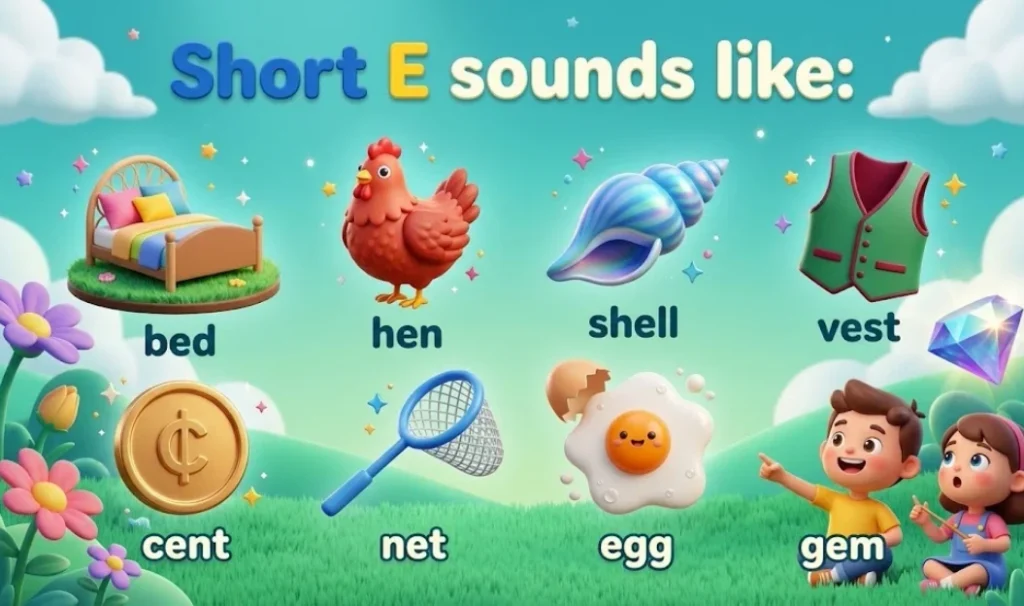
The short E sound is the vowel sound heard in words such as bed, pen, hen, and red. It is represented by the phonics symbol /ɛ/ or the child-friendly notation ĕ.
Listen to the middle sound in pen: /p/ /ĕ/ /n/. The vowel sound is short E.
The letter E can also make a long E sound, as in see and green. Children should practice hearing the difference instead of assuming that every word containing E uses the same sound.
Short E Words for Kids
These words are useful for children practicing the short E sound.
| Word | Example Sentence |
|---|---|
| Bed | I made my bed. |
| Beg | The dog may beg for food. |
| Bet | I bet you can do it. |
| Den | The fox went into its den. |
| Fed | She fed the cat. |
| Gem | The gem sparkled. |
| Get | I will get my bag. |
| Hen | The hen laid an egg. |
| Jet | The jet flew high. |
| Leg | My leg is tired. |
| Let | Let me help you. |
| Men | The men walked home. |
| Met | We met at the park. |
| Net | The ball hit the net. |
| Pen | I wrote with a pen. |
| Pet | My pet is a rabbit. |
| Red | The apple is red. |
| Set | Set the cup on the table. |
| Ten | I have ten crayons. |
| Vet | The vet helped my dog. |
| Web | A spider made a web. |
| Wed | They will wed in June. |
| Wet | My shoes are wet. |
| Yes | Yes, I can help. |
Some words in this list, such as wed and beg, may be less familiar to younger children. Start with everyday examples such as bed, pen, red, pet, and wet.
Three-Letter Short E Words
Many short E words follow the consonant-vowel-consonant pattern, often called CVC. The first and last sounds are consonants, with the short E sound in the middle.
| Word | Sounds |
|---|---|
| Bed | /b/ /ɛ/ /d/ |
| Beg | /b/ /ɛ/ /g/ |
| Den | /d/ /ɛ/ /n/ |
| Fed | /f/ /ɛ/ /d/ |
| Get | /g/ /ɛ/ /t/ |
| Hen | /h/ /ɛ/ /n/ |
| Leg | /l/ /ɛ/ /g/ |
| Men | /m/ /ɛ/ /n/ |
| Net | /n/ /ɛ/ /t/ |
| Pen | /p/ /ɛ/ /n/ |
| Pet | /p/ /ɛ/ /t/ |
| Red | /r/ /ɛ/ /d/ |
| Set | /s/ /ɛ/ /t/ |
| Ten | /t/ /ɛ/ /n/ |
| Wet | /w/ /ɛ/ /t/ |
How to Practice Sounding Out Words
Take the word bed as an example.
- Say the first sound: /b/.
- Say the middle sound: /ɛ/.
- Say the last sound: /d/.
- Blend the sounds together: bed.
Repeat the process with pen, hen, and red. Encourage your child to say the sounds aloud rather than guess the word from its first letter.
Short E Word Families
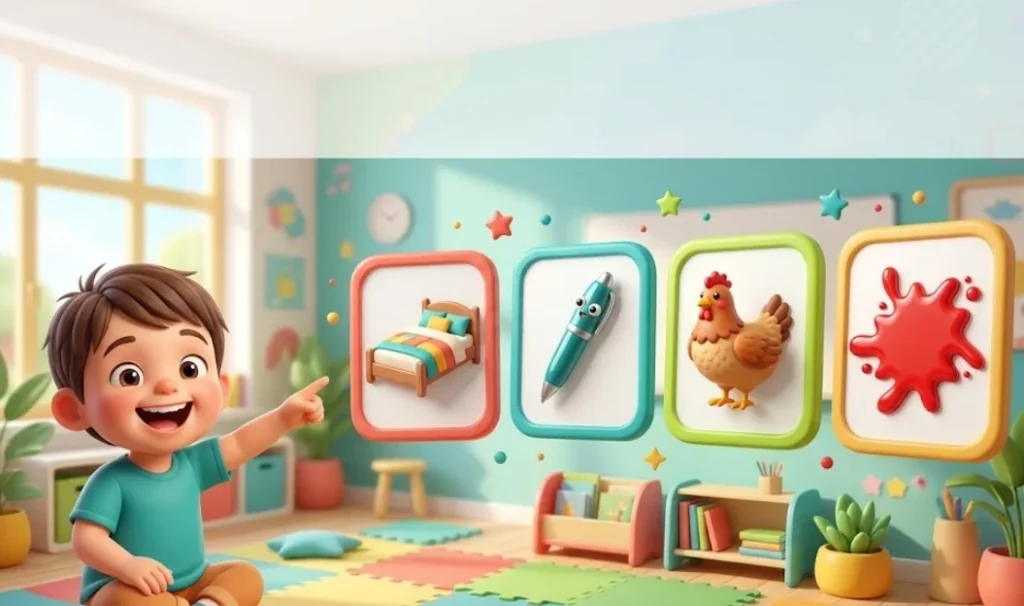
Word families contain words with the same ending sound and spelling pattern. They help children recognize familiar chunks in new words.
The -et Word Family
- Bet
- Get
- Jet
- Let
- Met
- Net
- Pet
- Set
- Wet
Example: The pet got wet.
The -en Word Family
- Den
- Hen
- Men
- Pen
- Ten
- When
Example: The hen sat near the pen.
The -ed Word Family
- Bed
- Fed
- Led
- Red
- Wed
Example: The red hen sat on the bed.
The -eg Word Family
- Beg
- Leg
- Peg
Example: The peg fell beside my leg.
Ask your child to read each group aloud. Then cover the first letter and see whether they can identify the shared ending.
Short E Words With Consonant Blends
A consonant blend occurs when two or more consonants appear together and each sound can still be heard. Some short E words begin with blends, while others end with them.
| Word | Blend |
|---|---|
| Blend | bl |
| Bless | bl |
| Cleft | cl |
| Dress | dr |
| Fled | fl |
| Flesh | fl |
| Fresh | fr |
| Fret | fr |
| Sled | sl |
| Slept | sl |
| Spend | sp |
| Spent | sp |
| Stem | st |
| Step | st |
| Trek | tr |
| Trend | tr |
These words are generally more suitable after children have become comfortable with simpler CVC words.
Short E vs. Long E Words
The letter E can represent more than one vowel sound. Comparing similar words can help children hear the difference.
| Short E | Long E |
|---|---|
| Bed | Bead |
| Pet | Pete |
| Met | Meet |
| Red | Read |
| Set | Seat |
| Hen | He |
| Net | Need |
In the first column, the vowel has the short E sound. In the second column, the E sound is long, as in the name of the letter E.
Have your child read each pair aloud. Ask them to notice how the vowel sound changes even when the words look similar.
Words With E That Make Different Sounds
Not every word containing the letter E uses the short E sound. These examples help children hear different vowel patterns.
| Word | Vowel Sound |
|---|---|
| Egg | Short E |
| Elephant | Short E at the beginning |
| Even | Long E at the beginning |
| Evening | Long E at the beginning |
| Enough | The first E has a different vowel sound |
| Eye | Begins with the /aɪ/ sound |
| These | Long E |
| Theme | Long E |
| Green | Long E |
| Complete | Contains a long E sound in its final syllable |
Read the words aloud and ask children to listen carefully to the vowel. Begin with familiar examples such as egg, elephant, and even before introducing less familiar words.
Things That Start With E
Everyday objects are a useful way to connect vocabulary with real life.
- Envelope
- Eraser
- Easel
- Engine
- Elevator
- Earring
- Egg
- Eggplant
- Earth
- Eye
Activity: Ask your child to point to an object in a picture or around the room. Say its name together and identify the letter E at the beginning.
Animals That Start With E
Children often enjoy learning animal names, especially when the words are paired with pictures.
- Eagle
- Elephant
- Eel
- Elk
- Emu
- Earthworm
- Egret
- Echidna
Try these simple sentences:
- The elephant has a long trunk.
- The eagle flies above the trees.
- The eel swims through the water.
- The emu is a large bird.
Ask your child which animal they would most like to see in real life.
Foods That Start With E
These food words can be practiced during meals, grocery shopping, or picture-matching games.
- Egg
- Eggplant
- Edamame
- Eclair
- English muffin
- Endive
- Elderberry
- Empanada
Example sentence: I ate an egg and an English muffin for breakfast.
For younger children, begin with familiar foods such as eggs. Introduce less familiar names with pictures or simple explanations.
Action Words That Start With E
Action words, also known as verbs, describe what a person or animal does.
- Eat
- Earn
- Echo
- Edit
- Enter
- Enjoy
- Escape
- Erase
- Explain
- Exercise
- Examine
- Exchange
Examples:
- We eat lunch together.
- Please erase the extra mark.
- The children enjoy playing outside.
- I exercise with my family.
Ask your child to act out a word such as eat, enter, or exercise. Acting out words can make their meanings easier to remember.
Positive E Words for Kids
Positive vocabulary helps children describe feelings, behavior, and personal qualities.
- Eager
- Easygoing
- Earnest
- Excellent
- Excited
- Enthusiastic
- Encouraging
- Energetic
- Empathetic
- Entertaining
Explain unfamiliar words in child-friendly language. For example, an empathetic person tries to understand how someone else feels. An enthusiastic person shows excitement about an activity.
Children can practice these words by choosing one that describes how they feel or how a character behaves in a story.
E Words in Example Sentences
Reading words in complete sentences helps children understand how vocabulary works in everyday communication.
- The egg is in the bowl.
- The elephant walks slowly.
- I eat breakfast every morning.
- The eagle flies over the trees.
- My ears help me hear music.
- Please erase the wrong answer.
- The red pen is on the desk.
- The hen sat in its nest.
- I enjoy reading a story.
- We went east to visit our friends.
- The empty box is on the floor.
- I saw an eel at the aquarium.
- The excited child opened the gift.
- We exercise in the park.
- The engine makes the car move.
After reading each sentence, ask your child to point out the E word. Older children can write their own sentences using the same vocabulary.
How to Teach E Words to Kids
Short, regular activities can make vocabulary and phonics practice part of a child’s daily routine.
1. Use Picture Cards
Show a picture of an egg, elephant, eagle, or envelope. Say the word and invite your child to repeat it. Then ask which letter the word starts with.
2. Practice the Beginning Sound
Say egg, elephant, and exit. Ask your child to listen to the first sound. Explain that the name of the letter E and the sound it makes in a word are not always the same.
3. Build Words With Letter Cards
Use letter cards to build bed, pen, and red. Have your child say each sound, then blend the sounds into a complete word.
4. Read Words in Groups
Practice rhyming groups such as pen, hen, ten or pet, net, wet. Ask your child what the words have in common.
5. Use E Words in Daily Conversation
Point out E words while reading books, preparing food, or playing with toys. For example, you might say, “Please put the egg in the bowl.”
For additional spelling practice, use these essential spelling words for kids.
Fun Short E Activities
These activities give children a chance to practice short E words while keeping lessons engaging.
Short E Word Hunt
Write bed, red, pen, hen, and net on separate cards. Ask your child to read each word and circle the ones with the short E sound.
Match the Word to the Picture
Prepare pictures of a bed, pen, hen, and net. Write each word on a separate card. Have your child match each word to the correct picture.
Complete the Missing Letter
Write these words with one missing letter:
- B_d
- P_n
- R_d
- H_n
- N_t
- W_t
Answers: bed, pen, red, hen, net, wet.
Make a Rhyming Chain
Start with pen. Ask your child to make new words by changing the first letter: hen, ten, and den. Repeat with pet, net, and wet.
Sort Short E and Long E Words
Write these words on cards: bed, red, see, green, pet, and meet. Ask your child to sort them into two groups: short E and long E.
Short E Quiz for Kids
Use this quick quiz to check whether children can recognize the short E sound.
1. Which word has the short E sound?
A. Bed B. Bike C. Boat
2. Which word rhymes with pen?
A. Pin B. Hen C. Pan
3. Which word begins with E?
A. Dog B. Egg C. Cat
4. Which word has the long E sound?
A. Red B. Pet C. Green
5. Which word completes the sentence?
“I write with a ___.”
A. Pen B. Pan C. Pin
Answers: 1. A, 2. B, 3. B, 4. C, 5. A.
Quick Reference: E Words for Kids
Use this table for a quick review of the main word groups.
| Category | Examples |
|---|---|
| Easy E words | Egg, ear, eat, easy, east |
| Three-letter E words | Ear, eat, egg, eel, end, eye |
| Four-letter E words | Each, earn, east, easy, echo, edge |
| Five-letter E words | Eager, eagle, earth, elbow, empty |
| Short E words | Bed, red, pen, hen, ten, net |
| Animals beginning with E | Eagle, elephant, eel, elk, emu |
| Foods beginning with E | Egg, eggplant, edamame, eclair |
| Action words beginning with E | Eat, enter, enjoy, erase, exercise |
| Positive E words | Eager, excellent, excited, energetic |
Frequently Asked Questions
Easy E words include egg, ear, eat, eye, end, east, easy, and echo. These familiar words are useful for early vocabulary and spelling practice.
Short E words for kindergarten include bed, red, pen, hen, ten, net, pet, wet, leg, and web. They help children practice the short E vowel sound.
The short E sound appears in words such as bed, pen, and red. The long E sound appears in words such as see, green, and meet. The vowel sound changes from word to word.
Use picture cards, read simple words together, build words with letter cards, and practice short sentences. Keep sessions brief, repeat familiar words, and introduce new ones as your child becomes more comfortable.
Animals beginning with E include elephant, eagle, eel, elk, emu, egret, echidna, and earthworm.
There is no fixed number for every child. Start with five to ten words, depending on the child’s age and reading ability. Repeat familiar words and add new ones when the child is ready.
Final Thoughts
Practicing E words can help children build vocabulary, recognize letters, improve spelling, and develop early reading skills. Start with familiar words such as egg, eat, and elephant, then introduce short E words such as bed, pen, and red.
Use simple sentences, picture cards, word families, and short games to make practice part of everyday life. With regular practice and encouragement, children can become more confident readers, one word at a time.